The Fifty-Pence Archive: Inside the Micro-Labels Mining Britain's Car Boot Sales
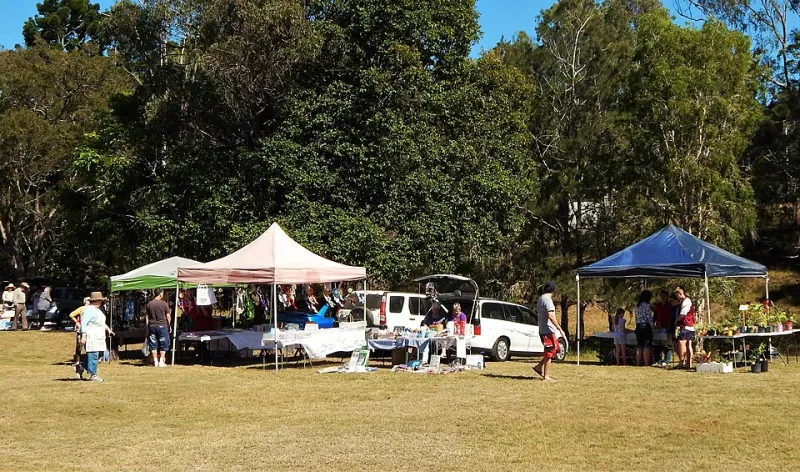
Photo: RegionalQueenslander, CC BY-SA 4.0, via Wikimedia Commons
It is 6.15am on a Sunday and the field outside Taunton is already full of transit vans. A man in fingerless gloves is unloading boxes marked “folk / psych / spoken / junk”. A woman in a waterproof coat is crouched over a crate of records, holding each sleeve up to the grey light. Somewhere near the burger van, a dealer is arguing about the price of a box set that nobody wants. This is the British car boot sale, and for a certain kind of record hunter, it is the most important A&R meeting of the week.
Over the past few years, a loose network of micro-labels and charity-shop diggers has been rescuing records that were never meant to travel far: private-press folk from the West Country, DIY synth tapes from the Home Counties, spoken-word LPs made by community groups, provincial punk singles pressed in runs of 200. These are not lost classics. They are local artefacts, made by people who had something to say and a mate with a tape machine. And they are being reissued, often for the first time, to listeners who are hungry for exactly that kind of oddness.
The boot sale as a regional archive
Car boot sales are not curated. That is the point. A single crate can contain a 1970s folk LP recorded in a village hall, a cassette of synth experiments from a comprehensive school, a spoken-word record about the closure of a local factory, and a copy of Now That’s What I Call Music 14. The randomness is the archive. It is also the problem: for every genuine find, there are a hundred scratched copies of Dire Straits.
The diggers learn to spot the signals. Hand-glued sleeves. Xeroxed inserts. A label address in a town nobody has heard of. A track listing that includes “The Ballad of the Bypass”. A recording credited to a name like “The Reverend Colin and the Parishioners”. These records were often made in small quantities, sold at gigs or through local shops, and never distributed beyond a thirty-mile radius. When they turn up at a car boot sale, it is usually because someone has died, moved house or given up on the loft.
Meet the diggers
Muddy Tapes (Bristol) specialises in West Country private-press folk and rural psychedelia. The label’s founder, a former charity-shop volunteer, describes the work as “social archaeology with a record cleaning brush”. Recent releases have included a 1978 LP recorded in a church hall in Somerset and a cassette of children’s songs from a Bristol playgroup. The sleeves are reproduced faithfully, including the original typos.
Pannier Press (Leeds) focuses on DIY synth and tape culture from the north of England. Its releases tend to come with thick booklets of oral history, interviews and photographs. The intention is not to make the music seem more important than it is, but to show how it was made and who made it. “These records were often made by people who did not think of themselves as artists,” the label says. “We want to keep that amateur energy, not polish it away.”
The Parish Office (Norwich) is a one-person operation devoted to spoken word, community radio and local documentary recordings. Its catalogue includes a 1980s LP about the Norfolk Broads, a tape of a pensioners’ reminiscence group, and a single by a punk band from a nearby village. The label is careful about consent: every reissue is licensed, and every artist or their estate is contacted first.
Vulcan Records (Sheffield) deals in provincial punk and post-punk singles. The label’s founder spends most weekends at car boot sales and closing-down sales, looking for records that were pressed in small numbers and sold at gigs. “The big reissue labels want the famous stuff,” he says. “We want the stuff that was made in a shed.”
The ethics of rescuing a record
Reissuing obscure records is not a neutral act. There are questions of ownership, consent and money. Who owns the master tapes? Who gets paid? What happens when the artist is dead, or cannot be found, or does not want to be remembered? The best micro-labels are careful about this. They license the recordings, pay royalties, and involve the artists in the packaging. They also accept that some records will remain lost.
The worst treat the car boot sale as a free-for-all. They press up records without permission, slap on a new cover and call it a “lost classic”. This is not preservation; it is extraction. The difference matters, because the value of these records is not just in the sound. It is in the local memory they carry: the factory closure, the village hall, the school project, the band that played three gigs and split up.
Keep the oddness
There is a risk that reissuing these records makes them too normal. A private-press folk LP that was recorded in a front room and pressed on a budget can become a tasteful streaming playlist, stripped of its context and its rough edges. The best labels resist this. They keep the crackle, the mistakes, the spoken introductions, the sleeve notes that explain who made the tea. They understand that the oddness is the point.
For listeners, these reissues are a way into scenes that would otherwise be invisible. They connect the experimental music fan in London to a synth tape made in a Yorkshire bedroom, the folk collector to a church-hall recording from Somerset, the punk historian to a single pressed in a Sheffield garage. They are not just records; they are small acts of local memory.
How to dig without being a pillock
If you want to join the hunt, start early. Take cash. Be polite. Do not haggle over fifty pence. Ask before you photograph anything. Do not clean a record with your shirt. And remember that the person selling it might have a story about it, if you ask nicely. The best finds are not always the most valuable ones. Sometimes they are the ones that tell you something about a place you have never been.