Next Bus, Next Movement: The Rural Shelters Turning Timetables Into Setlists
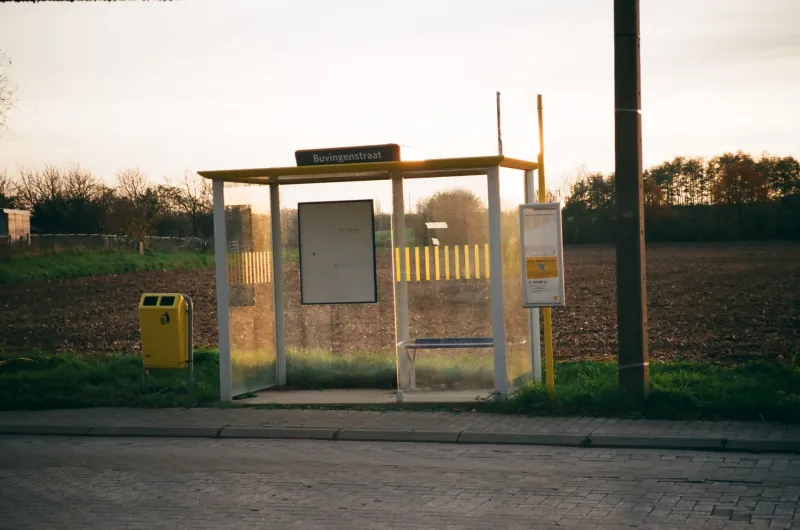
At 4.41pm on a Thursday in October, the light over the Pennines had gone the colour of weak tea and eleven people were standing in a bus shelter outside a village whose name I've agreed not to print. The bus was due at 5.12. Nobody was talking about the bus.
On a folding stool at the far end, a woman in a quilted jacket was bowing one long note on a cello while a shruti box breathed underneath. The shelter — glass on three sides, a concrete bench, a timetable in a scratched aluminium frame — did something to the sound that no village hall has ever managed. The note struck the back panel, met its own reflection, and settled into a slow beating chord that made the timetable buzz in its housing. When the 5.12 finally arrived, nobody clapped, because clapping would have been weird. Everyone just got on.
A reverb chamber with a bench in it
Anyone who has waited forty minutes in the rain for a cancelled service knows a shelter is not a neutral box. Sealed shelters with polycarbonate panels behave like short, bright rooms; older concrete-and-glass jobs, common across the Welsh borders and the Yorkshire Dales, smear the mid-range into a soft blur. The bench acts as a baffle, the roof as a low ceiling, and a wet road outside supplies a drone bed for free.
'The first time I played in one I thought the instrument had broken,' says Mira Halstead, a sound artist based in Hebden Bridge who has spent two years recording and performing in shelters along the Calder Valley. 'It hadn't. The shelter was just holding the note longer than I was. It's the cheapest reverb in Britain and it comes with a bin.'
Halstead's Waiting Rooms series, begun in 2024, sets field recordings of engines, doors and indicator ticks against live bowed cello. She plays through a small battery amp, though on quieter routes she doesn't bother.
The adopters
Not all of this is artist-led. In Powys, a parish council clerk who asked not to be named has run an informal adopt-a-shelter arrangement since 2022: residents sweep, reattach loose panels, and occasionally book a musician. 'We had a harpist in June,' she says. 'The bench was full and a man brought a flask.'
In Norfolk, the folk singer Danny Okoro has played unamplified sets at stops along a coastal route for three summers. His rule is simple: he starts after the last scheduled bus of the afternoon and stops the moment one appears. 'The bus is the interval,' he says. 'You don't fight the timetable, you work with it.'
And in the Scottish Borders, a route locals call the 47 to Nowhere — twice a day, frequently cancelled — has become a semi-regular venue for contact-mic experiments, with artists clipping pickups to the timetable frame and amplifying the hum of passing traffic through it. A recording from one of those sessions, all low rumble and a door that wouldn't shut, circulated widely last winter.
Waiting as a discipline
The etiquette is developing fast. Don't block the bench. Don't play through a scheduled service. Keep sets under twenty-five minutes, because that is about as long as anyone will stand in the cold without a reason. Bring a bin bag. And if someone is actually waiting for a bus, they win — every time. The audience, in other words, is anyone who happened to be there, plus a handful of people who came on purpose and stand slightly awkwardly at the edge.
'People say it's about reclaiming public space,' Halstead says. 'It isn't, really. It's about noticing that the space was already doing something. We just turned up with instruments.'
Paperwork at the stop
A shelter is, technically, a highway asset. Ownership sits with the local authority; maintenance often falls to the parish. Unamplified performance usually needs no licence, but anything amplified can require permission, and public liability insurance is the sort of thing that makes a twenty-minute cello set feel like a small administrative project. Some councils have been game; others have asked, reasonably, whether the bench is really the point.
'We don't want to be precious about it,' says one Somerset arts officer involved in a 2026 pilot pairing musicians with six rural stops. 'The bus is the bus. If we can make the waiting better without getting in the way, fine.'
What the 47 to Nowhere knows
It would be easy to make this sound like whimsy. It isn't entirely. Rural bus services have been cut back across England, Wales and Scotland for years, and a shelter is often the last piece of public infrastructure a village has left. Playing in one is a way of paying attention to that, not a way of ignoring it. That is also why the better sessions are short, unglamorous and slightly interrupted.
The one I saw ended mid-phrase. The cello stopped, the doors hissed open, and eleven people got on a bus that was, for once, four minutes early. The shelter went back to being a shelter. That, everyone agreed afterwards, was the whole idea.