Shuttered No More: The Empty Shopfronts Becoming After-Dark Sound Galleries
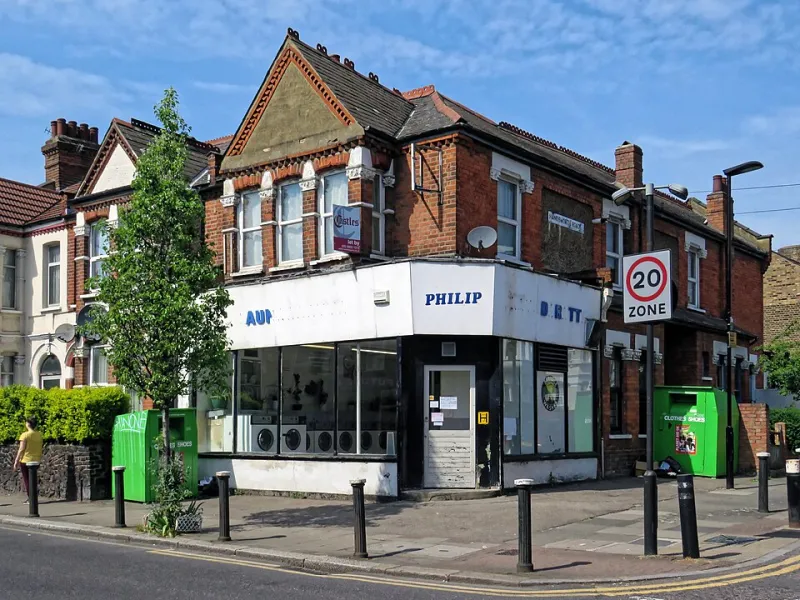
Photo: Acabashi, CC BY-SA 4.0, via Wikimedia Commons
On a damp Tuesday in Blackpool, a former card shop on Church Street is humming. Not loudly. More of a low, persistent thrum, like a fridge thinking about something. Two teenagers stop in front of the glass, phones half-raised, trying to work out where the sound is coming from. There is no door open, no ticket desk, no invigilator in a lanyard. Just a window, a timer switch, and a small directional speaker angled at the pavement.
This is the new late-night gallery format quietly spreading through British high streets. In Blackpool, Dover and Wrexham — and a scattering of other towns — artists are taking over empty retail units and turning the shopfront itself into the exhibition. No opening hours. No admission fee. No pressure to buy a postcard. You walk past, you look in, you listen. Then you walk on.
A gallery with no door and no closing time
The mechanics are simple, which is part of the appeal. A landlord has a unit sitting empty. A local authority or business improvement district has a small pot of money and a nagging worry about the high street. An artist has an idea that does not require a white cube, a private view, or a mailing list. The result is a window, some vinyl lettering, a loop pedal, and a timer.
Most of the projects run from dusk until the small hours, sometimes 24 hours. The work is often sound-based — field recordings, spoken word, manipulated noise — because sound travels through glass and does not need to be lit. But there are also projections, kinetic sculptures that twitch behind the glass, and text pieces that scroll slowly enough to read from the bus stop.
The format bypasses almost everything that makes traditional galleries expensive: invigilation, insurance for visitors, climate control, opening-hours staffing. Instead, the costs are a peppercorn rent (sometimes zero), a few hundred quid for materials, and the artist's time. That is both the beauty and the problem.
Blackpool: illuminations, arcade hum, and a captive bus queue
In Blackpool, the project is called Sea Front Static, and it occupies a former fancy goods shop a few doors down from a Wetherspoon. The artist, who asks not to be named because she is negotiating another unit nearby, has layered recordings of the illuminations switch-on, arcade cabinets, tram bells, and the particular squawk of Blackpool gulls. It loops every 14 minutes.
The window faces a bus stop, which means the audience is essentially captive. "You get people who have missed the 11 back to Cleveleys and they just stand there," she says. "They don't know it's art. They just know it's better than looking at a shuttered phone shop."
Blackpool is a useful test case because the town already has a long, complicated relationship with light and spectacle. The illuminations are a civic ritual. The empty shopfronts are not. Putting a low hum in a dead retail unit is a way of acknowledging both — the town's theatrical past and its current, more threadbare reality — without turning it into a postcard.
Dover: a waiting room without a door
Dover's contribution is a former travel agent on the high street, a few minutes' walk from the port. The piece is by a local duo who record what they call "the town's transit choir": ferry announcements, hovercraft noise, foghorns, the air brakes of lorries queuing for the continent. It is 11 minutes long and loops hourly from 7pm until 5am.
What makes it work is the context. Dover is a town of people passing through, and the window becomes a sort of waiting room without a door — a place to pause without having to buy a coffee or explain yourself. On the night I visited, a lorry driver stood in front of it for the full loop, eating a bag of crisps, then walked back to his cab.
The project is funded through a small grant from the local BID and the goodwill of a landlord who is "between tenants". That phrase comes up a lot in these schemes. It is the sound of a temporary arrangement being made permanent enough to be useful.
Wrexham: a market town hears itself
In Wrexham, the window is a former butcher's near the market, and the piece is in Welsh and English. It uses recordings from the indoor market, a chapel harmonium, and — inevitably — a distant chorus of football chants from the Racecourse. The artist, who grew up in the town, describes it as "a listening post for people who think they know what Wrexham sounds like".
The piece is not nostalgic. It includes the sound of the bypass, the retail park, and the self-checkouts at the big Asda. It is a portrait of a town that has changed, and is still changing, and is not entirely sure what it wants to be. The window does not resolve that. It just makes space for it.
The funding question: who pays for a window?
None of these projects rely on Arts Council England project grants. That is deliberate. The application process is long, the reporting is heavy, and the sums involved are often smaller than the cost of a decent projector. Instead, the money comes from BIDs, small council discretionary funds, landlord contributions, and the artists themselves.
The upside is speed and freedom. A window can open in weeks, not months. The downside is precarity. Artists are often unpaid or paid a token fee. If the speaker breaks, there is no maintenance budget. If the landlord finds a tenant, the piece comes down with a week's notice.
"We call it meanwhile use because it sounds better than 'we're looking after an empty shop for a bit'," one organiser in Dover tells me. "But meanwhile is doing a lot of work in that sentence."
Regeneration or holding pattern?
The honest answer is that it is both, and neither, depending on the town. In Blackpool, the window galleries have coincided with a small uptick in evening footfall, according to the local BID, though nobody is claiming they have solved the high street. In Dover, the project is as much about giving residents something to look at as it is about attracting visitors. In Wrexham, the art is part of a broader conversation about Welsh language and identity that predates the empty shops.
What the format does well is provide free, un intimidating access to experimental work after dark. You do not need to know what a sound installation is. You do not need to book. You do not need to feel like you are in the wrong clothes. That is not nothing.
What it does less well is create lasting change. Landlords use the windows to keep units looking "activated" while they wait for a developer or a chain. The art is a placeholder. When the lease is signed, the speaker comes down and the window goes back to being a window.
That does not make the projects pointless. It makes them honest. The high street is in flux, and these artists are working with the flux rather than pretending it isn't there. The question is whether councils and landlords will ever pay for the work properly, or whether the format remains a stopgap that looks like regeneration until the scaffolding goes up.
Where to look
If you want to find these windows, you will not find them on a gallery website. Look for lit shopfronts after 9pm that do not look like they are selling anything. Look for small speakers, timers, and vinyl text. Ask in local cafes. Check BID newsletters. The best ones are often the ones nobody has bothered to publicise.
For now, the high street's loss is the night owl's gain. Stand still for a minute. Listen. Then move on before the last bus goes.