Patch Cables and Tea Urns: Inside the Village-Hall Synth Clubs Rewiring Amateur Music
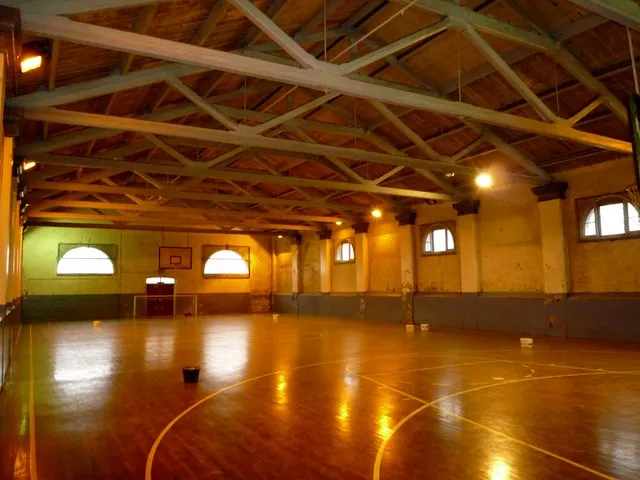
Photo: J Taylor, CC BY-SA 2.0, via Wikimedia Commons
The first thing you notice is the kettle. The second is the smell — that sweet, faintly metallic haze of rosin flux, the same one that used to hang around school electronics clubs and now hangs around a parish hall twelve miles outside Norwich on the second Thursday of every month.
By half seven, two trestle tables have been shoved together and covered with a cut-down camping mat, a shared soldering station, three multimeters and a shoebox labelled KNOBS, MISC. A woman in her seventies is being talked through a theremin kit by a boy of about fourteen. Neither of them appears to think there's anything odd about this.
This is the East Norfolk Synthesis Circle — a name that changes roughly every year and a membership that doesn't. Around twenty-five people, aged fourteen to eighty-one, meeting in village halls on a rota, because no single parish will have them more than once a quarter. “We're too loud for some, too nerdy for others, and we do leave a smell,” says Priya, who runs the group's bulk-order spreadsheet and, by common consent, most of its logistics. “Three complaints in four years. That's not bad going.”
Cheap kit, expensive ideas
There is a particular kind of instrument that turns up at these nights, and it costs about the same as a takeaway for two. Korg Volcas bought second-hand. Atari Punk Consoles built from schematics printed off forums. A Bastl Kastle with a snapped leg that someone has repaired with a bent paperclip and unreasonable confidence. One member turns up with a biscuit tin, two contact mics and a length of elastic and spends forty minutes making it sound like a bus shelter in the rain.
The group buys components together — resistors in bags of five hundred, jack sockets by the hundred, a shared reel of shielded cable that has outlived two committee chairs. “Individually, postage kills you,” says Malcolm, a retired agricultural engineer who repairs the soldering irons and refuses to be thanked for it. “Together, it's thirty quid each and you've got a rig.” If a city synth meet is often about showing off what you've got, the village version is stubbornly about what you can make from what's in the drawer.
The evening splits roughly in two: an hour of bench work, then an hour of playing. Not performing, exactly. A lamp gets moved to the back of the hall, the stacking chairs go into a semicircle, and whoever wants to plays for as long as they want to, which is usually somewhere between four and twelve minutes.
The intergenerational bit isn't a gimmick
It would be easy to write this up as a heartwarming story about teenagers teaching pensioners to solder, and it would also be wrong. The traffic goes both ways, and often diagonally.
The fourteen-year-old knows the kits. The seventy-something knows why a hall's electrics buzz when the urn is on, how to earth a chassis properly, and which of the three local electricians will sign off a PAT test in exchange for a lift to the wholesaler. Someone in their thirties turns up with a modular case and spends most of the night patiently explaining that no, you don't need it, and no, it isn't better than your biscuit tin.
“There's no scene to break into,” says Callum, twenty-six, who drove fifty minutes from the coast to be here. “In a city you're constantly measuring yourself against people who've been doing it for a decade and have a label. Here it's like — show us what you built, then let's have a cup of tea. I've made more music in a year of this than in five years of going to nights in London.”
Listening to the parish
Running alongside the making is a quieter project: an archive. Several of these groups have started recording the sounds of the places they meet — the click of a gate latch on the footpath, the churn of a grain dryer, the specific squeak of the hall's fire door, the quarter peal from the church tower recorded badly and then recorded well.
The Cumbrian contingent has been at it longest. One member has spent three winters building a map of the Eden Valley's ambient sound — a project that began as a way of testing a cheap field recorder and turned into something closer to a civic service. The recordings get played at the meetings, sometimes processed into drones, sometimes left exactly as they were captured, all of it filed with a date and a grid reference on a hard drive that lives in a biscuit tin of its own.
It's here that the groups start to look less like hobby clubs and more like the sort of thing that usually gets a funding officer excited. Several have done small commissions with local museums or parish councils. One built a temporary installation in a church porch for a summer fete, which mostly involved a lot of extension leads and a long conversation about insurance.
The rural advantage
Ask the organisers why this works here rather than in a city and you get a surprisingly consistent answer: the hall.
A village hall is cheap, acoustically strange, entirely unglamorous and completely unbothered about looking cool. It has a kitchen. It has a car park. It has a caretaker who will tell you, firmly and correctly, that you are not to use the stage lights because the dimmer is on its last legs. Nobody is trying to photograph the room for a listings site.
“The whole idea of a venue with a capital V is a city thing,” says Priya. “Out here the hall is the venue, the church is the venue, the pub back room is the venue. You stop worrying about the room being right and start working with the room you've got.”
The obvious limits are real. Transport is a nightmare, and anyone without a car is dependent on a lift rota that gets complicated in winter. The 10pm curfew imposed by neighbours isn't a creative constraint so much as a hard stop. Membership skews older and whiter than the groups would like, and everyone knows it.
But the model is spreading anyway — a new club in a Fenland village, another forming in the Welsh borders, both taking advice from the Norfolk spreadsheet. The advice is boring and practical: find a hall with a decent caretaker, buy in bulk, keep the kettle on, and don't call it a scene. Call it a Thursday.