Bells, Sticks and Static: Morris Sides Are Plugging Into the Noise Underground
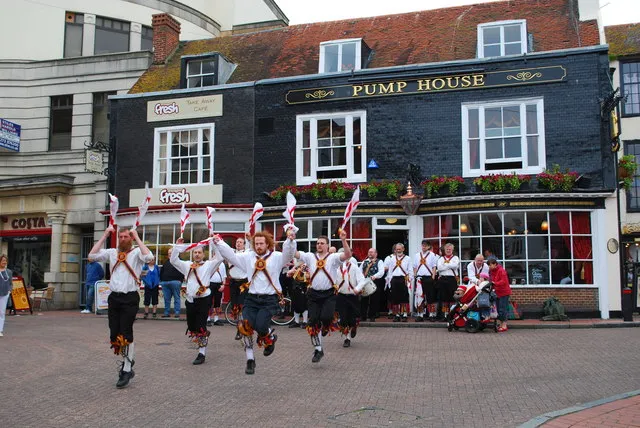
Photo: william, CC BY-SA 2.0, via Wikimedia Commons
On a damp Saturday in Herefordshire, the village hall smells of tea, floor polish and the faint metallic tang of a borrowed smoke machine. A morris side is lined up in white, bells strapped at the knee, sticks in hand. At the back of the room, behind a folding table, a musician is threading a contact mic through a loop pedal. Nobody is treating this as a support slot. The noise act is not warming up the crowd for the dancers. It is part of the dance.
This is not a one-off. Through 2026, a loose network of morris sides and experimental musicians has been quietly pairing up across England—in Lancashire mill towns, Norfolk villages, Sheffield community centres and a surprising number of pub gardens. The collaborations are small, often unpaid, and frequently advertised by laminated poster. But they are reshaping what both traditions think they are doing.
The bell pad as an instrument
Morris has always been percussive. The bells are not decoration; they are rhythm. The sticks are not props; they are impact. What the 2026 collaborations add is amplification and a willingness to treat those sounds as raw material rather than accompaniment.
In one setup, contact mics are taped directly to the bell pads. The jingle of a dozen dancers becomes a dense, metallic chatter that can be fed through spring reverb, delay or a cheap overdrive pedal. The result is not a folk band with effects. It is a room-sized instrument played by moving bodies.
"People think we're adding noise to morris," says a musician from a Sheffield noise duo who has spent the year working with a side in the Peak District. "We're not. We're just turning up the volume on what's already there. The bells were always the weirdest part. We're letting them be weird."
Sticks, contact mics and the art of the near-miss
The stick dances are trickier. A contact mic on a wooden stick picks up every tap, scrape and near-miss. In a small hall, that can tip into feedback. The dancers have had to learn where to stand, how hard to strike, when to hold back. The musicians have had to learn the dance's timing—not just the beat, but the pauses, the crossings, the moments when the side breathes together.
At a June 2026 date in a Norfolk village hall, the collaboration nearly came apart when a feedback squeal cut through the opening figure. The squire kept going. The musician ducked the frequency. By the third dance, the squeal had become a drone that sat underneath the sticks like a held breath. Nobody clapped until the end. Then they clapped for a long time.
"You can't just turn up with a pedalboard and expect it to work," says a dancer in her sixties who has been with her side for more than three decades. "They had to watch us. We had to listen to them. It's a conversation. Sometimes a row."
What the village makes of it
The audiences are not the usual experimental music crowd. They are neighbours, parents, people who came for the tradition and stayed for the drone. In one Gloucestershire hall, a retired teacher said the bells had "got a personality" she had never noticed before. A parish councillor worried about the volume. A teenager filmed the whole thing for a social media account devoted to "weird rural stuff".
The bar takings, by several accounts, have been good. The hall committees have been pleased. The collaborations have also brought younger people into rooms they might otherwise never enter—and brought older morris audiences into contact with sound art they might otherwise dismiss.
Not everyone is convinced. One side in the North West withdrew from a planned 2026 date after complaints that the noise "ruined the tunes". Another musician describes a village where the local paper ran a letters page debate about whether contact mics counted as "authentic". The collaborations have not resolved that argument. They have made it audible.
Folk ritual and noise: a mutual reshaping
Morris is already strange. It involves disguise, sticks, bells, trespass, seasonal obligation and a willingness to dance in public without obvious reason. Experimental music is also a ritual: setup, duration, attention, the shared agreement that a room can be an instrument. The two forms recognise each other.
The noise musicians are learning about audience, weather, timing and the social contract of a village hall. The morris sides are learning about texture, duration and the possibility that a dance can be listened to as well as watched. Neither side is claiming to have invented anything. They are just following the sound.
"People say we're ruining morris," says one squire. "Then they say we're saving it. I don't think it needs saving. It needs stretching. It's survived worse than a loop pedal."
Where it goes next
There are more dates planned for the rest of 2026: a pub garden in Derbyshire, a church in Suffolk, a community centre in South Yorkshire. The collaborations remain deliberately scruffy. No one is talking about an album. No one is applying for a large grant. The point is the room, the bells, the feedback and the tea urn.
At the Herefordshire hall, the final dance ends with the musician holding a single bell tone under a wash of tape hiss. The side stands still, breathing. The audience is quiet. Then someone's chair scrapes. The spell breaks. The kettle goes on.
"The drone is just the bell's shadow," the musician says afterwards, packing up a pedalboard held together with gaffer tape. "You just have to stand in the right place to hear it."