Down the Steps, Into the Room: Britain’s Former Public Loos Are Learning to Play Host
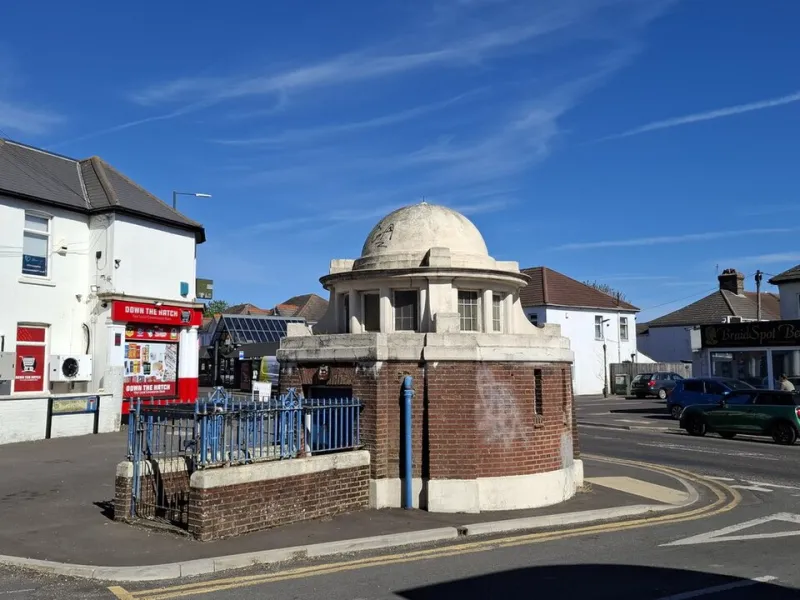
Photo: Malc McDonald , CC BY-SA 2.0, via Wikimedia Commons
There is a particular sound to a room that was built for plumbing rather than people. It is bright, a little slappy, and it makes every footstep feel like it belongs to someone else. Down a set of worn steps, past a railing and a sign that still says something about opening hours, a growing number of former public toilets are being used for gigs, sound installations and listening sessions. In 2026, this is less a novelty circuit than a quietly persistent strand of Britain’s small-venue ecology.
The appeal is not difficult to understand. These are rooms with built-in character: glazed tiles, concrete floors, low ceilings, heavy doors and the faint memory of water. They are also small, cheap-ish and often sitting empty in the middle of towns that could do with something happening in them. For promoters used to black-box venues with predictable acoustics, a former conveniences block offers the opposite: a room that argues back.
The room does half the work
Acoustically, a disused loo is not a neutral container. Tiled walls bounce high frequencies around; concrete floors and ceilings can reinforce a hard, immediate sound. Low ceilings compress the space, especially for drums and amplified instruments, and the rectangular footprint means standing waves are part of the deal. Artists tend to either fight this or lean into it. The ones who lean in often use sparse setups — a single oscillator, a contact mic on a pipe, a voice without too much reverb — because the room already supplies the reflections.
Water-fed installations make a kind of sense here. Cisterns, drainage channels and old pipework can become resonating chambers or rhythmic sources. One artist on the 2026 circuit has been using the building’s original plumbing as a slow, gurgling percussion section, with microphones clipped to copper and a sub-bass speaker placed where the hand dryer used to be. It is not subtle, but it is site-specific in the most literal way: the building is not a backdrop, it is a collaborator.
From Victorian cisterns to DIY rigs
Most of these rooms hold 30 to 60 people at a push. That changes the social contract. Audiences are close enough to see the sweat on a performer’s hands, and there is nowhere to hide at the back. Promoters describe a different kind of attention: less chatter, more curiosity, and a willingness to tolerate the odd drip. The programming tends to follow suit — short sets, sound art, spoken word, quiet electronics, the kind of acts that would be swallowed by a club PA but can fill a low-ceilinged room with detail.
Community groups are part of the story too. Some former conveniences are run by volunteers, friends-of groups or small arts organisations that took on a building the council no longer wanted to maintain. They are not trying to create a rival to the local O2 Academy. They are trying to make a room work. That often means borrowing chairs, borrowing lights, and asking the audience to bring a cushion if they plan to sit on the floor.
Damp, drains and the planning desk
The romance fades slightly when you talk to anyone who has tried to make one of these spaces usable. Damp is a constant. Ventilation is often inadequate. Drain smells can return in warm weather. Accessibility is a serious issue: steep steps, narrow doors and low head-height are not quirky details if you use a wheelchair or have limited mobility. Licensing, fire safety and change-of-use planning all have to be sorted, and the heritage lobby can be both an ally and an obstacle. Listed tilework and original fittings are worth protecting, but they also make it harder to insulate, ventilate or reconfigure a room.
There is a tension, too, between preserving a building’s history and using it. A former public convenience is a civic building with a slightly embarrassing function; some locals would rather see it filled than fenced off. Others worry that turning it into a venue is the first step towards privatising a public asset. The most thoughtful operators seem to split the difference: keep the building open, keep it cheap, and be honest about what it can and cannot do.
A fragile second act
The economics remain fragile. Small capacities mean small door takings. Grants help, but they are not a long-term plan. Some spaces survive by hosting rehearsals, workshops and recording sessions alongside gigs. Others rely on a loyal local audience and a promoter who is willing to lose money on a Thursday. The 2026 circuit is not a boom; it is a collection of modest experiments that happen to share a architectural type.
Still, there is something useful in these rooms. They remind you that a venue is not just a stage and a bar. It is a set of surfaces, a height, a smell, a way of moving through a door. Britain has plenty of former public toilets and plenty of artists looking for somewhere strange to play. For now, the two are finding each other down a set of steps, under the pavement, with the tiles still doing their thing.