The Hum Beneath the Hand Dryer: Motorway Services as Listening Rooms
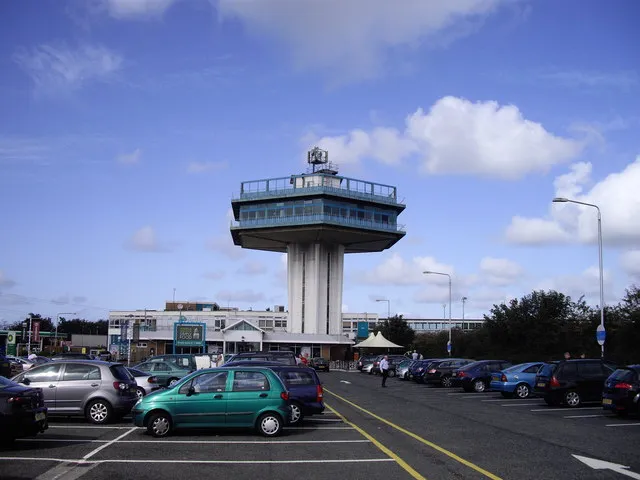
Photo: PAUL FARMER, CC BY-SA 2.0, via Wikimedia Commons
At 11.47pm on a wet Tuesday, the westbound services near Reading are doing what they always do: humming. The tannoy has stopped announcing that the hot food counter is closed. A hand dryer barks in the toilets. Beyond the automatic doors, lorries idle in rows, their engines settling into a low, patient note. In one corner of the seating area, a small speaker plays a tone so deep it seems to come from the building itself. This is one of the overnight sound installations that have been appearing at UK motorway services through 2026 — less a gig than a shift change in how we hear the roadside.
The 2am audience
There is no stage. No ticket desk. No support act. The audience arrives in fragments: a lorry driver with a cardboard coffee, a nurse coming off shift, a couple sharing a bag of crisps, a cleaner moving between tables. Some know the piece is playing. Most do not. They sit inside it anyway.
The artists behind these works are not trying to fill the room with themselves. They are trying to disappear into it. Contact microphones go on extractor fans and hand dryers. Piezo discs are taped to handrails and sliding doors. Tannoy announcements are recorded, stretched, and fed back at low volume. Passing traffic becomes a rhythm section, filtered until the car park sounds like a tide. The result is drone, but not the stern, black-clad kind. It is the drone of a building with its shoes off.
Why the services?
Because they are open. Because they are warm. Because they have toilets, seating, step-free routes and a car park that does not care what time it is. Late-night experimental music often asks audiences to navigate unreliable trains, half-lit industrial estates and venues with a single accessible entrance. A motorway services is not perfect, but it is a rare indoor public room that does not require a ticket, a pint or a password. It is also a place where nobody looks twice at someone sitting alone at 2am.
Then there is the architecture. Service stations are some of Britain's most overlooked buildings: glass boxes, flat roofs, fluorescent grids, ventilation ducts, laminated signs. They are designed to move people through, not to make them stay. That tension is exactly what makes them interesting. The best pieces do not try to turn the services into a concert hall. They turn your attention to the fact that it was already full of sound.
What the artists are doing
On a practical level, it is a tangle of permission, patience and gaffer tape. Artists work with site managers, often after hours, and keep volumes low enough that a tannoy can still be heard. Some pieces use a single speaker and a bench. Others use a short-range headphone station, or a low-power transmitter that only reaches the seating area. The materials are not glamorous: HVAC hum, extractor fans, order bells, trolley wheels, the beep of a self-service till, the sigh of automatic doors.
The most effective works share a rule: do not make life harder for the people working there. No blocking aisles. No recording customers without consent. No messing with fire alarms. The installation has to fit around the night shift, not the other way round. When it does, something odd happens. The room becomes more legible. You notice how the air moves. You hear the building as a system.
How to attend
Most of these pieces are announced through artist mailing lists, local listings and cards near the coffee counter. Some sites use QR codes on small posters. The usual window is 10pm to 6am, but times vary. Bring wired headphones in case there is a listening point, a warm layer, and change for parking. Check access before you travel: not every services has step-free routes to every seating area, and quiet corners are rare. If you are driving, do not listen while driving. Stop, park, and sit with it.
The etiquette is simple. Buy a tea if you can. Do not film strangers. Do not treat the staff as part of the piece. If a piece is too quiet to hear, move closer rather than asking for the volume to go up. And if you find yourself bored, stay a little longer. Roadside drone is not a spectacle. It is a lesson in adjusting.
The politics of loitering
There is a contradiction at the heart of this. Service stations are commercial spaces designed to keep people moving. Sitting for too long can attract a security check. The installations only work if they are invited, and they only stay honest if they do not pretend the building is something it is not. The artists who do this well are not romanticising the roadside. They are paying attention to it, including the awkward bits: the price of a sandwich, the loneliness of the night shift, the cold walk back to the car.
That is also what makes the work accessible. You do not need to know the difference between a Serge modular and a radiator. You just need to be in the room. The hum was always there. The installation simply asks you to hear it.
By the time the sky turns grey over the car park, the piece is winding down. The tannoy starts again. The hand dryer barks. A lorry reverses with a warning beep. The room goes back to being a room. But for a few hours, it was also a listening space — and nobody had to buy a ticket.