The Kiosk Frequency: Britain's Red Phone Boxes Are Now One-Person Listening Rooms
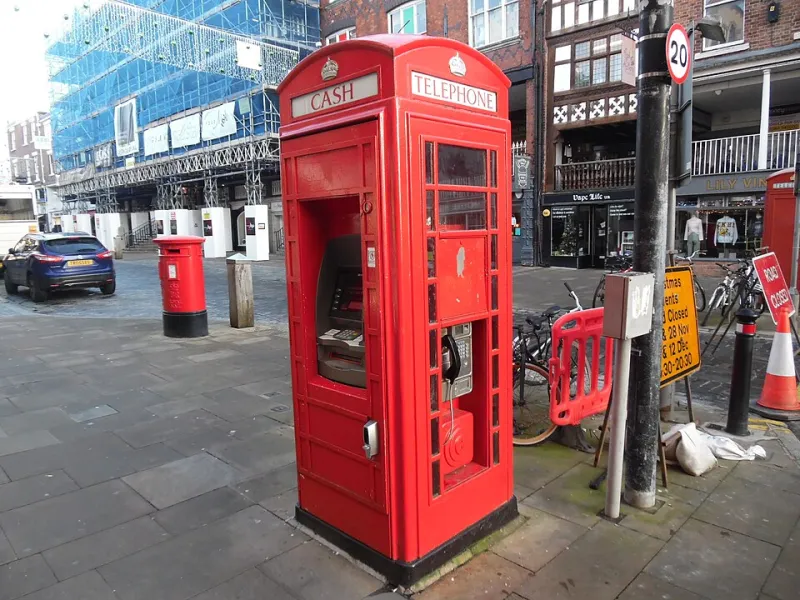
Photo: David Hillas , CC BY-SA 2.0, via Wikimedia Commons
There's a moment — standing inside a decommissioned phone box on the Lizard with a cold bakelite handset against your ear — when the embarrassment lifts. It takes about forty seconds. Before that you're a grown adult wedged into a red glass cube on a cliff, holding a phone that hasn't carried a call since 2014, listening to a recording of the sea you can already hear behind you. After it, you get it. The box is doing the one thing it was always good at: putting a single voice uncomfortably close to a single ear.
That's the appeal, and it's why a quiet wave of conversions has been building across the UK. Not gigs, not installations in the usual sense — just small, weatherproof, faintly ridiculous rooms for one person at a time to listen to something strange. In a year when the conversation about live experimental music keeps circling scale (bigger festivals, bigger screens, bigger ticket prices), the kiosk is the opposite argument. Three feet by three feet. No bar. No support act. No audience to perform for.
A pound, a key, and a parish council
The mechanics are unglamorous. BT's Adopt a Kiosk scheme lets community groups, parishes and — in theory — individuals take on a redundant box for £1. The catch is that you don't get to move it, you don't get to change what it looks like, and you inherit every future repair. Ofcom figures have put the surviving red-box estate somewhere around the 20,000 mark, down from more than 90,000 at the turn of the century, and a lot of what's left sits on listed or conservation-area ground. That's the trade: cheap rent, permanent responsibility.
In practice, adopters tend to be parish councils, village halls, community trusts and the occasional stubborn individual with a research habit. Once the key is handed over, the real work starts — power, insurance (budget a couple of hundred a year), repainting, and the small matter of getting sound into a listed structure without drilling anything that would upset a conservation officer.
Cornwall: the kiosk that plays the sea back to you
On the coast path between Mullion and Kynance, a box has been quietly running since the spring on a solar panel and a sealed battery. Sound artist Ellie Trewin calls it a listening station, which is a polite way of saying she has hidden a small speaker inside the redundant handset and filled the rest with a hard drive of hydrophone recordings taken from the coves below.
"The first version just played the sea," she says. "Which is daft, because you're stood next to it. So I started layering — a recording of the sea from a hundred metres away, then from underwater, then the sound of the box itself in a gale. People stay in there for ages. They think they're being quick."
The cliffside kiosk has no door mechanism to speak of, no ticket, and no explanation beyond a laminated card. It also has the best attendance figures of anything Trewin has made. Dog walkers, coast-path completists, a man who comes every Thursday. Anecdote isn't data, but it's a pattern you hear repeated everywhere these conversions have taken root.
Birmingham: the button that changes every month
In Stirchley, on the southern edge of Birmingham, a box on a suburban corner has been adopted by a loose collective of about a dozen people who describe themselves, only half-jokingly, as a programming committee. Their version is closer to a gallery than a radio station. Inside: one large industrial button, wired to a Raspberry Pi in the roof space, which plays a single 90-second piece. On the first Sunday of each month, someone climbs a step ladder and swaps the file.
"We wanted something with no interface to learn," says one of the organisers. "You press it. It plays. You can't skip, you can't turn it up, you can't leave a comment. There's a real discipline to that, both for us and for whoever's listening."
The programming has drifted, as these things do. Month one was a piece built from the sound of the number 11 bus. Month four was a grandmother from down the road recounting a story about a flood. A local primary school did one entirely out of recorder practice. Funding came from a small community grant and a crowdfunder that overshot by £600, which paid for the repaint and a year of insurance.
The Highlands: Gaelic, hydrophones and horizontal rain
Further north, in a village on a single-track road in Wester Ross, a community trust took on their kiosk mostly because nobody wanted to see it go. The result is the most quietly ambitious of the three: a loop of field recordings, oral history and underwater sound gathered from the loch, with spoken contributions in Gaelic and English, all curated by a rotating pair of volunteers.
What's striking is how much of the material is about weather. Wind on the box itself. Rain on the roof. A recording of a ferry horn from four miles off. "It's not a sound art project, really," one volunteer tells me, slightly apologetically. "It's a memory project that happens to be in a phone box." That distinction matters. A lot of the most interesting work in this space isn't being made by artists at all — it's being made by people who wanted a landmark to keep doing something.
The permissions bit nobody puts on the postcard
Here's where the romance meets the paperwork. Sound in a public box means thinking about who else is nearby. A low-power FM transmitter covering thirty metres is still, technically, a broadcast, and Ofcom's licensing rules apply; most of the conversions I visited have sidestepped the issue with a speaker or a wired handset instead. Anyone wanting wider reach is looking at a Restricted Service Licence, which is doable but not the sort of thing you knock together in a weekend.
Then there's the building itself. If the kiosk is listed, internal fixings may need consent. If it sits on a village green, the parish council is your landlord in all but name. If it's on a beach or a National Trust path, add a landowner to the list. Power is the recurring headache — a spur from a nearby lamp post is a different conversation from a solar panel and a battery that sulks in February.
What a one-person room does to a scene
There's an obvious objection here: this isn't a scene, it's a novelty. A box that plays one drone to one person isn't a venue, and calling it one is the kind of thing that makes promoters roll their eyes.
But the novelty argument misses what these spaces actually do. They remove every social signal that tells you how to behave at experimental music — where to stand, when to clap, whether to nod. In a kiosk there's nobody to check. You either stay for forty seconds and feel daft, or you stay for ten minutes and hear something properly. The box, with its red glow on a dark coastal path, is a small lamp left on for somebody.
And practically, they're multiplying. Conversions have cropped up in Suffolk, South Wales, Sheffield and at least two motorway-adjacent villages, usually with the same ingredients: a £1 lease, a modest grant, one obsessive, and a piece of sound that couldn't fill a room but can absolutely fill a box.
On the way back from the Lizard I stopped at a kiosk I'd been told about but hadn't planned to visit — village green, bench opposite, no card explaining anything. I pressed the button. Nothing happened. I pressed it again. Somewhere a small fan started up, and then a low tone, definitely a drone, drifted out at conversational volume. I stood there for seven minutes. The phone box, which spent a century delivering bad news and quick goodbyes, has found a third career. It turns out the smallest room in Britain is also the quietest.